Shopify Conversion Rate Optimisation: How We Find the Leaks on Live Stores
Shopify conversion rate optimisation is not a list of tricks you copy from a competitor. It is a process: find where shoppers stall, work out why, fix the biggest leak first and prove it worked. This is the version we run on live accounts.
Key takeaways
- Shopify conversion rate optimisation is a repeatable process of research, hypotheses, prioritisation, testing and learning, not a bag of tactics.
- Start with the funnel numbers, then use heatmaps, recordings and short surveys to explain why shoppers stall at each step.
- Write every idea as a hypothesis and score it, so the team works on the biggest leaks rather than the loudest opinions.
- Collection pages, the cart and checkout friction often cost more sales than the product page, yet get far less attention.
- Judge results on revenue per visitor as well as conversion rate, and keep a learning log so you never pay for the same lesson twice.
01What Shopify conversion rate optimisation really means
Most founders who ask us about Shopify conversion rate optimisation have already tried something. A new banner, a countdown timer, a trust badge app, a free shipping bar. Sometimes the numbers moved for a week. Usually they did not, and nobody could say why. That is the gap a proper CRO process fills: it replaces guesses with evidence, and it tells you which change caused which result.
Our working definition is plain. Shopify conversion rate optimisation is the ongoing work of finding where shoppers drop out of your store, understanding why, and changing the store so more of them complete an order. Conversion rate is the share of sessions that end in an order. It is the headline number, but it is not the only one we watch, because a change that lifts conversion while cutting average order value can leave you worse off.
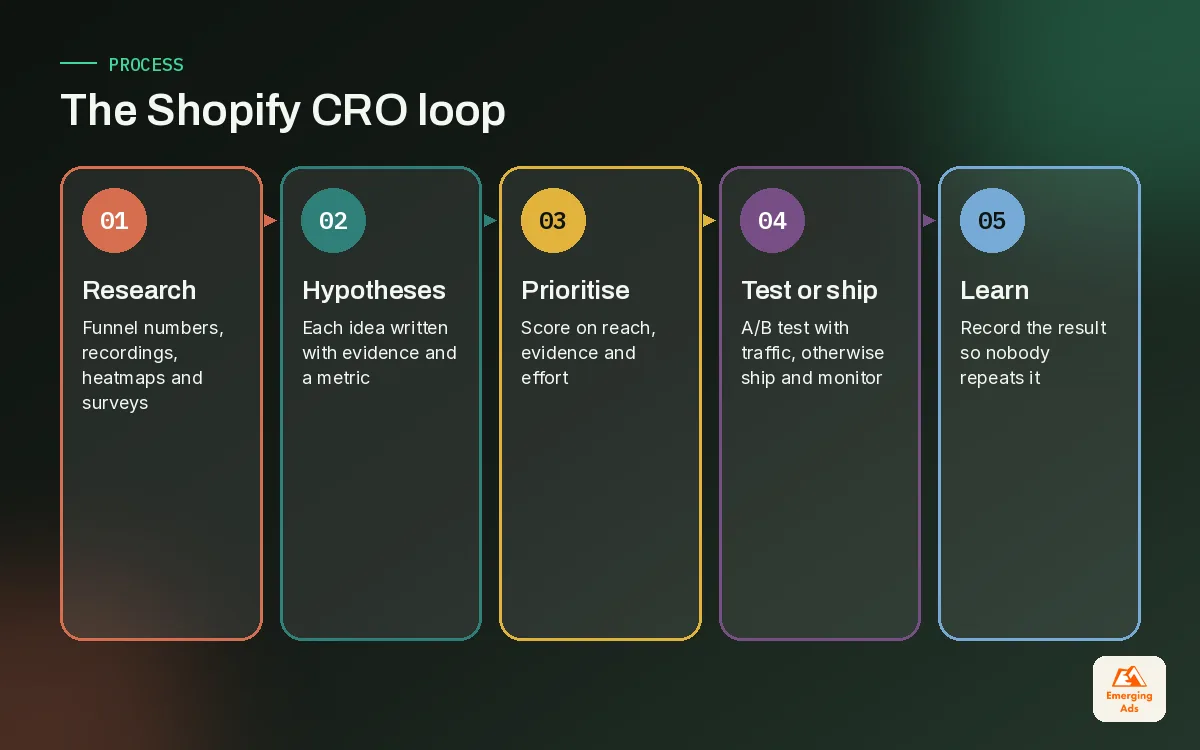
On the stores we work with, across beauty, supplements, pet, jewellery and home brands, the process always runs in the same loop:
- Research. Numbers first, then behaviour, then the shopper’s own words.
- Hypotheses. Every idea written as a clear, testable statement.
- Prioritisation. A simple score so the team works on what matters.
- Testing or careful rollout. Depending on how much traffic you have.
- Learning. A written record of what worked, what did not and why.
The loop never ends, which is the point. A store that runs it every month compounds small gains. A store that runs it once ends up with a pile of one-off fixes and no memory of what helped.
02Start with the numbers: reading your Shopify funnel
Before anyone opens a heatmap, we look at the funnel. Shopify Analytics and Reports, built into the admin, show sessions, add-to-cart rate, sessions that reached checkout and checkout completion rate. GA4, connected through the Google and YouTube app, adds landing page, device and traffic source detail. If either is set up badly, fix it first. A messy GA4 setup will send your CRO work in the wrong direction for months.
Cut the funnel four ways
A single store-wide conversion rate hides almost everything. We always split it by:
- Device. Mobile usually brings most of the traffic and a lower conversion rate. The size of that gap matters more than the absolute number.
- Traffic source. Paid social, Shopping ads, organic search and email behave like different audiences, because they are.
- Landing page type. Home, collection, product and campaign pages each have their own job.
- New versus returning. Returning visitors convert better almost everywhere. If yours do not, something is wrong with what they see on the way back.
The step with the steepest drop on your highest traffic segment is where research begins. On one supplements store, the store-wide figure looked fine. Split by device, mobile visitors from paid social were reaching the cart and then stopping at a far higher rate than anyone else. That one cut set the agenda for the next quarter.
| Funnel step | What to measure | What a sharp drop usually points to |
|---|---|---|
| Landing to product view | Share of sessions that open at least one product | Weak collection pages, poor filtering, a homepage that does not route people |
| Product view to add to cart | Add-to-cart rate | Unclear price, sizing doubt, slow page, missing delivery information |
| Cart to checkout | Share of carts that start checkout | Surprise costs, a cluttered cart, discount code hunting |
| Checkout to order | Checkout completion rate | Shipping cost shock, missing payment methods, forced account creation |
The right-hand column is a pattern from stores we have audited, not a rule. Use it to form questions, then let your own research answer them.
03Behaviour research: heatmaps, recordings and surveys
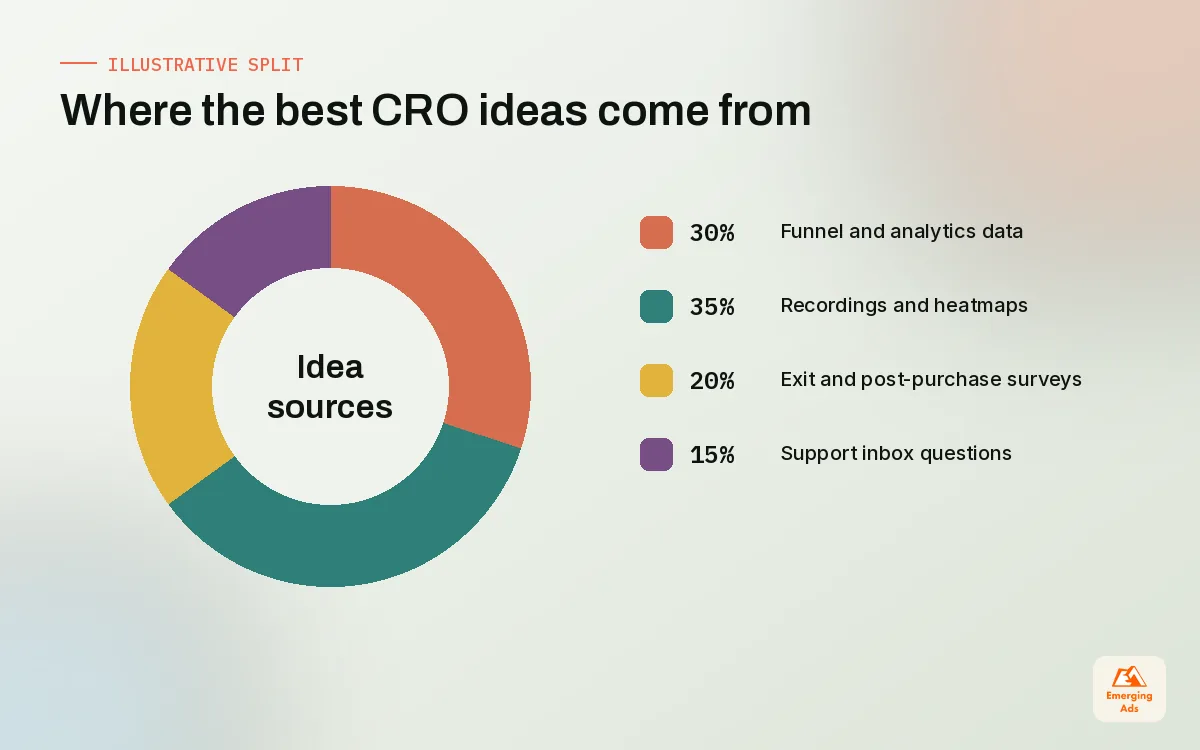
Numbers tell you where shoppers leave. Behaviour tells you why. This is the part of Shopify CRO most teams skip, and it is the part that produces the best ideas.
Heatmaps and scroll maps
Click and scroll maps show what people actually touch. On collection pages we look for taps on things that are not links, filters nobody uses and how far down the grid people get before giving up. Tools like Hotjar make this easy to set up, and our Hotjar heatmap service covers the setup and the reading of the maps, which is where most of the value sits.
Session recordings
We watch recordings with one question in mind at a time. For example: what happens in the twenty seconds before someone leaves the cart? Fifty recordings watched with a focused question beat five hundred watched at random. Patterns appear fast: rage taps on a disabled button, people opening the shipping page three times, shoppers zooming on a photo because the text is too small.
Short on-site surveys and customer questions
The cheapest research is asking. A one-question exit survey on the cart, such as “Is anything stopping you from ordering today?”, often names the problem in the customer’s own words. We also read the support inbox and post-purchase survey answers. When the same question appears week after week, the store is failing to answer it.
04From hunches to hypotheses: building a CRO backlog
Research produces dozens of ideas. Without structure they turn into a wish list that whoever shouts loudest gets to pick from. We write every idea in the same format:
Because we saw [evidence], we believe that [change] for [audience] will cause [effect], and we will know by watching [metric].
It feels formal the first few times. Then it becomes the most useful habit in the whole process, because it forces two things: an actual reason for the change and an agreed way of judging it. If nobody can fill in the evidence part, the idea goes to the bottom of the list.
How we prioritise
We score each hypothesis from 1 to 5 on three questions, then sort by the total:
| Factor | Question we ask | Scores high when |
|---|---|---|
| Reach | How many sessions see this part of the store? | It sits on a template with heavy traffic, such as the cart or main collections |
| Evidence | How strong is the research behind it? | Numbers, recordings and survey answers all point the same way |
| Effort | How easy is it to build and test? (higher means easier) | It is a theme setting or a small section change, not a rebuild |
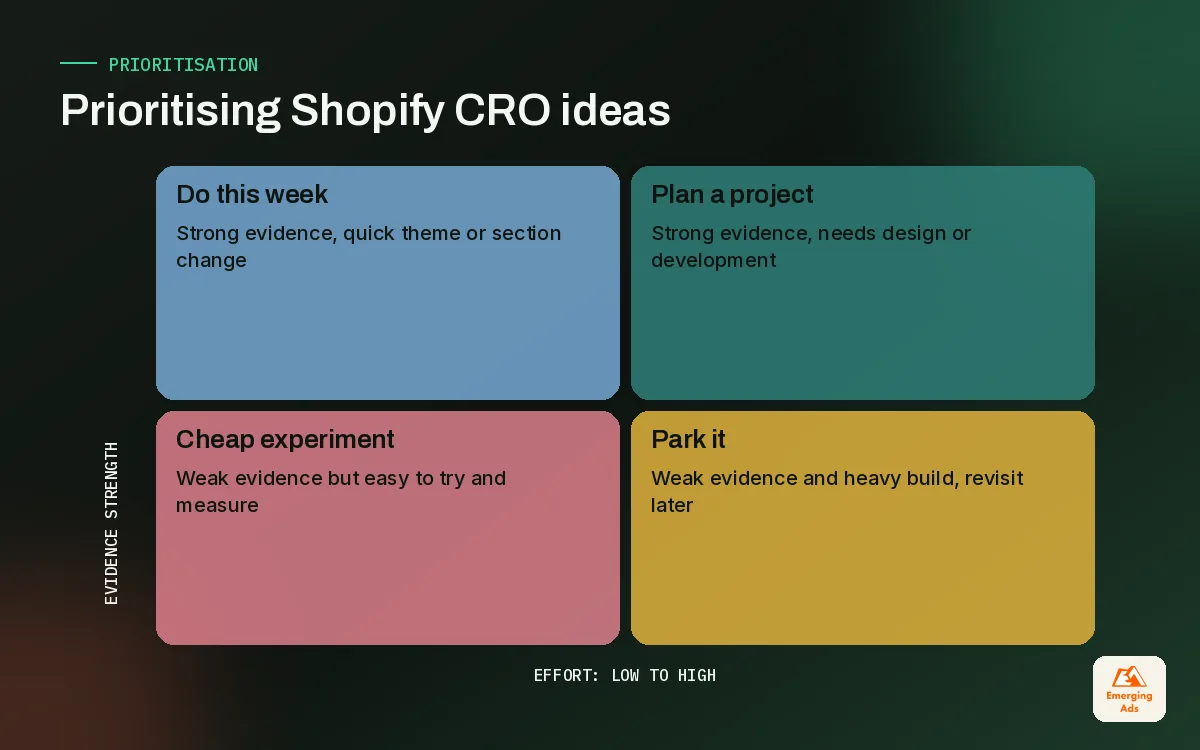
There are fancier scoring models. This one is simple enough that founders, designers and developers can all use it in the same meeting, and that matters more than precision. Ideas with high reach and high evidence but heavy effort become projects. High evidence, low effort ideas get done this week.
05Collection pages: the forgotten conversion step
Product pages get the attention, and our Shopify team has plenty to say about them elsewhere. But in Shopify conversion rate optimisation work we often find the bigger leak one step earlier. Paid social and email traffic frequently lands on a collection, and if the shopper cannot find something they want in a few seconds, they never reach a product at all.
- Default sort order. Bestsellers and in-stock items first. Sold-out products at the top of a grid are a quiet conversion killer.
- Filters that match how people shop. Size, skin type, room, material or price, depending on the category. Not twelve filters, the four that matter.
- Product cards that answer the first question. Price, a second image on hover or swipe, colour swatches and a review count where they help.
- A short intro at the top. One or two lines that tell the shopper they are in the right place, with longer copy lower down for search.
- Fast loading grids. Heavy images and too many apps hurt collections more than most pages. Our Shopify speed optimisation work often starts here.
When campaign traffic needs a sharper message than a standard collection can give, a dedicated campaign page is worth building. Online Store 2.0 makes that possible with sections on any template, and our landing page design team builds these to match the ad that sent the visitor.
A brief word on product pages
Product pages matter enormously, and they deserve their own guide. In this process they are simply one more step in the funnel: research them, write hypotheses, score them against everything else. Do not let them crowd out the collection, cart and checkout work below.
06Cart and checkout friction on Shopify
Checkout is where Shopify gives you the most help and the least freedom. Checkout customisation now runs through Checkout Extensibility, using checkout UI extensions and Shopify Functions, and checkout.liquid has been deprecated for the information, shipping and payment pages. That means old hacks may no longer apply, and you should be wary of anyone promising a fully redesigned checkout. What you control well is everything around it.
The cart
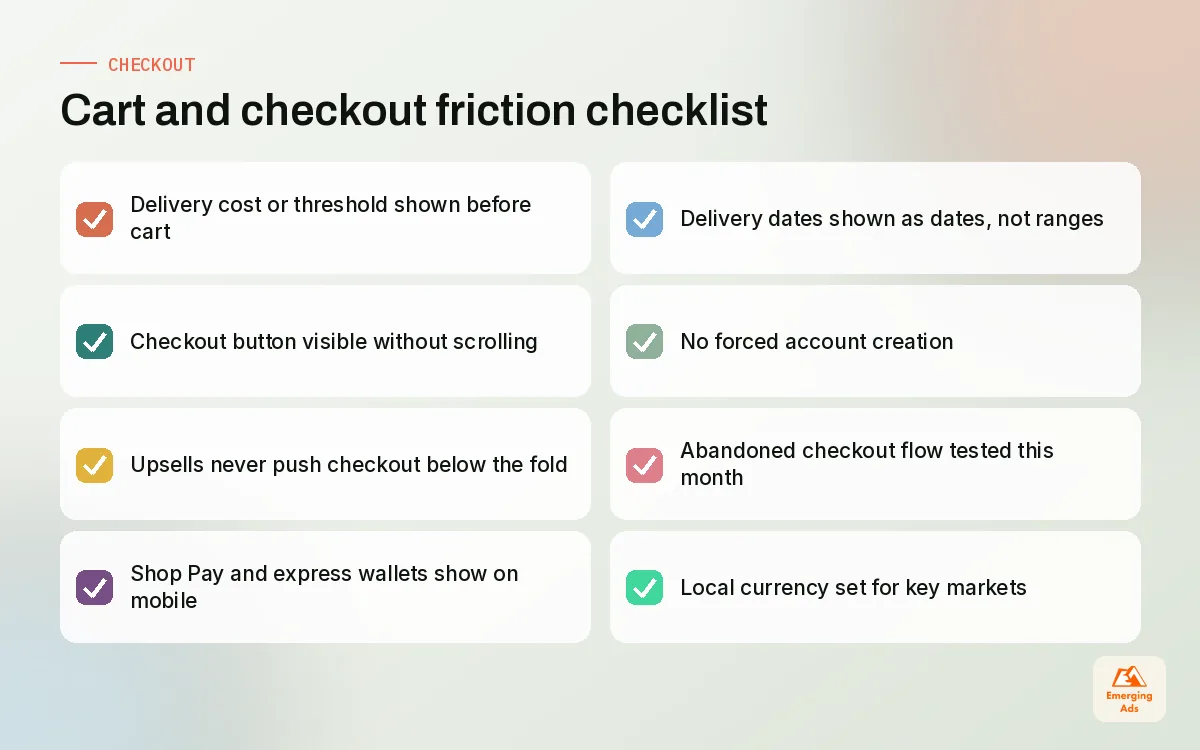
The cart is where shoppers check their decision. Keep it calm. Show the items, the total, the delivery threshold if you have one, and a clear checkout button. A cart drawer is usually better than a full cart page on mobile, but test it rather than assume. Watch for upsell blocks that push the checkout button below the fold.
Surprise costs
The most common checkout complaint we read in surveys is a delivery cost that appears too late. Show delivery costs or a threshold on the product page, the cart and in a site-wide bar. Nobody abandons a cost they already expected.
Payment and speed
Shop Pay, Shopify’s accelerated checkout, plus the wallets your customers actually use, shorten the path for returning buyers. Check that the express buttons show on mobile and that no app is hiding them. If you sell across borders, Shopify Markets handles local currencies and languages, which removes another reason to hesitate.
Recovery
Some shoppers will always leave. An abandoned checkout sequence that is timed well and written like a person, not a robot, recovers a share of them. We build these inside our email automation flows work, and we check them after every theme or app change, because they break quietly.
07Trust and offers: the levers people overuse
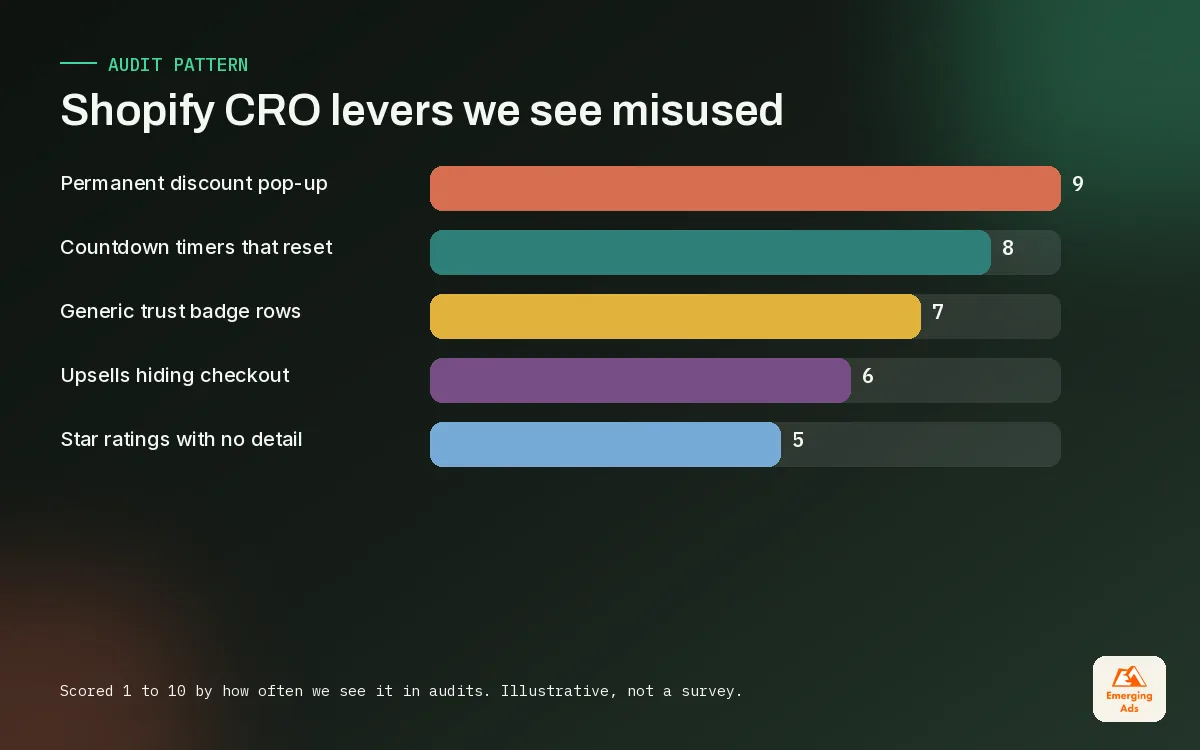
Trust badges and discounts are the two levers every Shopify store reaches for first. Both can work. Both are overused in ways that hurt.
Trust that actually reassures
A row of generic payment logos does very little. What reassures shoppers is specific: a clear returns promise in plain words, real reviews with photos, a visible way to contact a human, and delivery times stated as dates rather than ranges of days. On a pet food store, replacing a badge strip with a single line, “Not right for your dog? Send it back within 30 days”, did more than every badge we had tested.
Offers that do not train people to wait
A permanent discount pop-up teaches every visitor that full price is for suckers. We prefer offers with a reason: a first order incentive only for email sign-ups, a bundle that raises order value, a gift above a threshold. Test offers on revenue per visitor, not conversion rate alone, because a discount almost always lifts conversion and often lowers profit.
| Lever | Common misuse | Better approach |
|---|---|---|
| Trust badges | Generic logos stacked under the button | One specific promise on returns or delivery, near the price |
| Urgency | Fake countdown timers that reset | Real deadlines tied to delivery cut-offs or genuine launches |
| Discounts | Site-wide pop-up on every visit | Targeted first order offer, bundles or threshold gifts |
| Social proof | A star rating with no detail | Reviews that answer common doubts, with photos where possible |
08Testing on Shopify: A/B tests vs careful rollouts
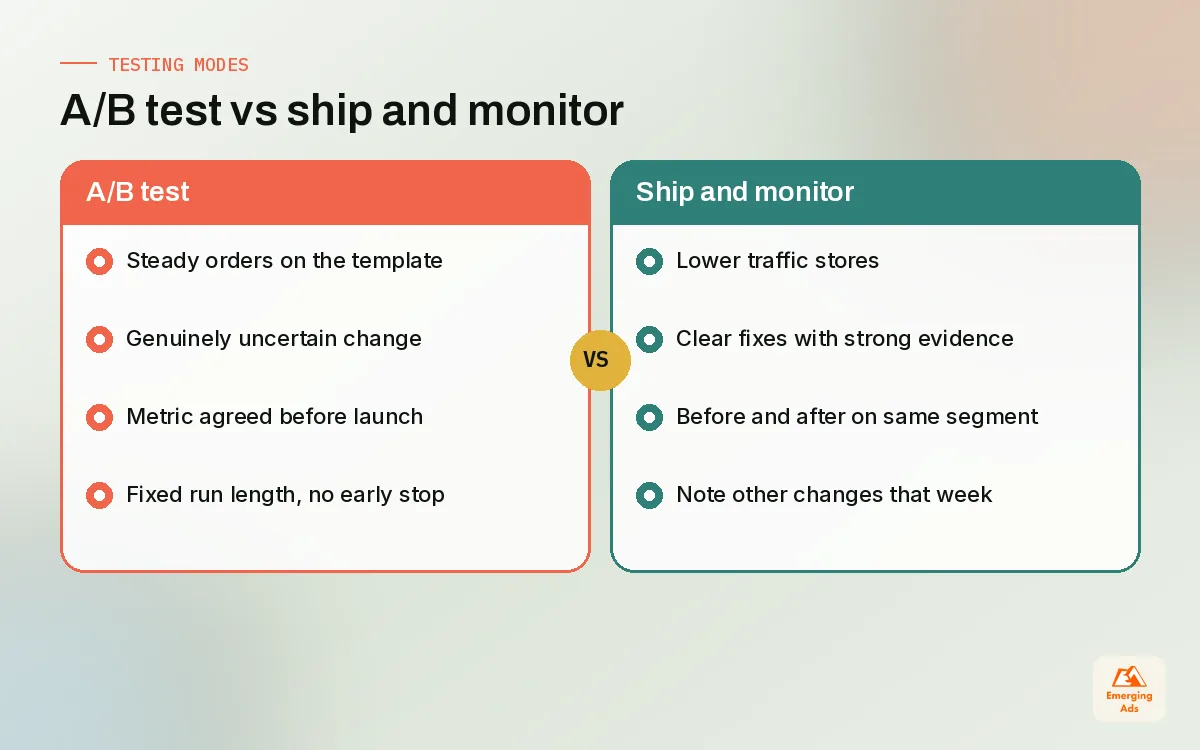
Proper A/B testing needs enough orders to reach a clear answer. On smaller stores, a test can run for months without a result, and that is time you could have spent fixing obvious problems. So we use two modes.
When to run a true A/B test
If a template gets steady traffic and orders, and the change is genuinely uncertain, split test it with a testing app or theme-based approach. Decide the success metric before the test starts, agree how long it will run, and do not stop it early because the first few days look exciting. They nearly always do, and it nearly always fades.
When to ship and monitor
If evidence is strong and the change is clearly an improvement, such as fixing a broken filter or adding delivery costs to the cart, just ship it. Compare a few weeks before and after on the same segments, and note anything else that changed in the same period. It is less precise than a test, and that is fine for obvious fixes.
Either way, reliable data is the foundation. If orders are not attributed properly, or events double count, every result is suspect. Our conversion tracking setup work makes sure pixels run through Shopify customer events, the supported way to add them, so test results can be trusted.
09Making Shopify conversion rate optimisation a monthly habit
The stores that win at Shopify conversion rate optimisation are not the ones with the cleverest ideas. They are the ones that keep the loop running. Our monthly rhythm is simple: review the funnel, watch recordings against one question, update the backlog, ship or test the top two or three items, and write down what happened.
That learning log is the asset. After a year, it tells you what your shoppers respond to, which saves real money on every redesign and campaign. It also stops new team members repeating tests that failed before they joined. Tidy store housekeeping helps too, and our earlier piece on the weekly routine for managing a Shopify store covers the habits that keep CRO gains from slipping.
If you want a team to run the process with you, our Shopify conversion optimisation service covers research, prioritisation, design and testing. For brands with other platforms or landing pages outside Shopify, our broader website CRO services use the same method. You can see how this fits with ads, email and analytics on our services overview, and if you want the theory behind it, our main site explains what conversion rate optimisation is and how it works.
Start small. Pull your funnel split by device this week, watch twenty recordings of people leaving the cart, and write your first five hypotheses. That is the whole method in miniature, and it is more than most stores ever do.
Frequently asked questions
Straight answers to what clients ask us most about shopify conversion rate optimisation.
What is Shopify conversion rate optimisation?
Where should I start with CRO on a Shopify store?
Do I need heatmaps and session recordings?
How much traffic do I need to A/B test on Shopify?
Can I customise the Shopify checkout for CRO?
Why do shoppers abandon the Shopify cart?
Should I judge CRO tests on conversion rate alone?
How do I prioritise CRO ideas?
Do trust badges improve Shopify conversion rates?
How long before CRO shows results?
Are collection pages important for conversion?
Want to know where your Shopify store is leaking sales?
We will walk through your funnel numbers, recordings and checkout with you and hand back a ranked list of the leaks worth fixing first.
Book your free audit