The Shopify Marketing Plan We Hand to Every New Client
Most Shopify marketing fails for a boring reason: too many channels started at once, none of them run properly. This is the plan we hand new clients, built around stage, margin and the few channels that actually suit a Shopify store.
Key takeaways
- Shopify marketing works best as a plan built around your store stage and margin, not a list of every channel available.
- Most stores need one strong acquisition channel, one search channel and an email programme before adding anything else.
- Retention through email, SMS and WhatsApp turns paid traffic into profit, so build it before scaling ad spend.
- A promotions calendar planned a quarter ahead stops panic discounting and gives creative teams time to do good work.
- Track a short list of numbers weekly, judge channels together, and move budget gradually rather than in dramatic swings.
01Why most Shopify marketing plans fail in the first 90 days
A founder launches a store, reads that brands grow on TikTok, hears that Google Shopping prints money, gets told email is where the profit sits, and starts all of it in the same month. Ninety days later every channel has a small budget, thin creative and no clear result. That is the most common Shopify marketing story we hear, and it is entirely avoidable.
Our view is simple. Shopify marketing is the plan that decides which channels bring people to your store, which ones bring them back, and how money and effort are split between them as the business grows. The plan matters more than any single tactic, because a mediocre channel run with focus beats a great channel run as a side project.
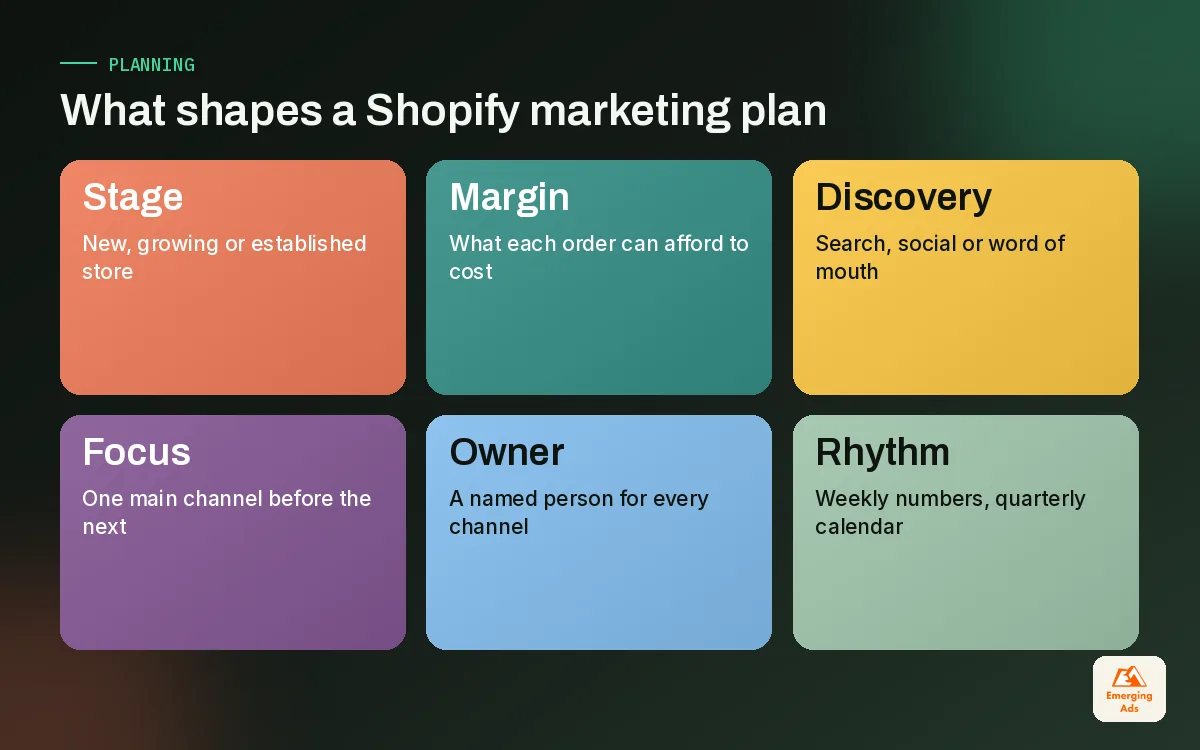
Three questions shape every plan we write:
- What stage is the store at? A new store needs proof that people will buy. An established one needs efficient scale and better retention.
- What does the margin allow? A product with healthy gross margin can afford paid acquisition. A thin margin product needs repeat purchases or bundles to make the maths work.
- How do customers already find you? Search demand, social discovery and word of mouth point to very different channel mixes.
Answer those honestly and the channel list mostly writes itself. The rest of this guide is how we turn the answers into a working plan.
02The Shopify marketing stack: build it in layers
We think of marketing for Shopify stores as layers, each one resting on the one below. Skipping a layer is the usual reason ad spend feels like it disappears.
- A store that converts. Fast pages, clear offers and a working checkout. If this is weak, every other layer leaks. Our guide to finding conversion leaks on a Shopify store covers the process.
- Tracking you can trust. GA4 through the Google and YouTube app, pixels through Shopify customer events, and a weekly scorecard everyone reads.
- Retention basics. Welcome, abandoned checkout and post-purchase emails running before serious ad spend begins.
- One main acquisition channel. Usually paid social or Shopping, chosen by how customers find your category.
- Search and content. Shopping ads, Performance Max and SEO to capture people already looking.
- Expansion. New channels, new markets through Shopify Markets, partnerships and video.
The order is not rigid. A brand with strong search demand may start with Shopping ahead of social. But we have never seen a store skip the first three layers and scale profitably for long.
03Acquisition channels for Shopify stores, compared
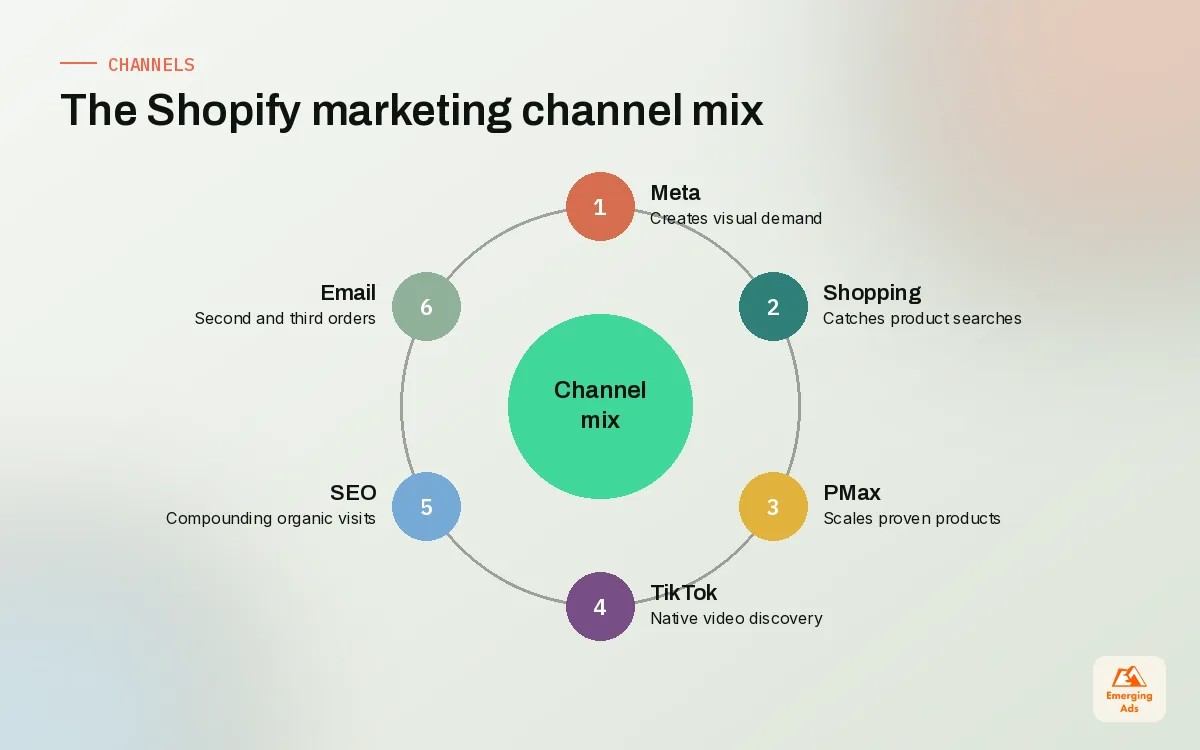
Each acquisition channel has a job it does well. The mistake is expecting one to do another’s job: asking TikTok to capture high-intent searches, or Shopping ads to build demand for a product nobody knows exists.
| Channel | Best at | Suits stores that | Main risk |
|---|---|---|---|
| Meta (Facebook and Instagram) | Creating demand with visual products | Have strong imagery, a clear hook and room in the margin | Creative fatigue if new ads are not made regularly |
| Google Shopping | Capturing people searching for the product | Sell things people already search for by name or type | Poor product data quietly limits reach |
| Performance Max | Covering Google’s inventory from one campaign | Have clean feeds, tracking and enough conversion volume | Spend drifting to brand terms and remarketing |
| TikTok | Discovery through native, creator style video | Have products that demonstrate well on camera | Treating it like a place for repurposed polished ads |
| SEO | Compounding traffic from collection and guide pages | Can wait months for results and keep publishing | Thin collection copy and duplicate product pages |
These are judgements from accounts we manage, not universal rules. Your category can change the picture, and the only real test is a focused budget with honest tracking.
Meta: the default first channel for most visual brands
For fashion, beauty, jewellery and home brands, Meta is usually where we start, because it can create demand rather than wait for it. The work is mostly creative: new angles, new hooks, new formats every few weeks. Our Meta ads for ecommerce team spends more time on briefs and testing than on bid settings, which is how it should be.
Google Shopping and Performance Max: catching existing intent
If people already search for what you sell, Shopping is often the most efficient channel you will run. Feed quality decides a lot of it: titles, product types, images and accurate prices. We usually begin with structured Google Shopping ads to learn which products earn their keep, then move proven lines into Performance Max campaigns with brand terms watched closely.
TikTok: discovery with a different creative brief
TikTok rewards video that looks like it belongs there: a person, a problem, a product, filmed simply. On a pet accessories store, a phone-filmed clip of a dog ignoring an expensive toy and then loving ours outperformed every studio asset that quarter. If your products show well in motion, TikTok ads for ecommerce can be a strong second acquisition channel.
SEO: the slow channel that keeps paying
Organic search is the channel founders most want and least want to wait for. Collection pages with useful intros, product pages with original descriptions and a handful of genuinely helpful guides build traffic that does not stop when the budget does. Our ecommerce SEO work on Shopify focuses on collections first, because that is where commercial searches land.
04Retention: email, SMS and WhatsApp
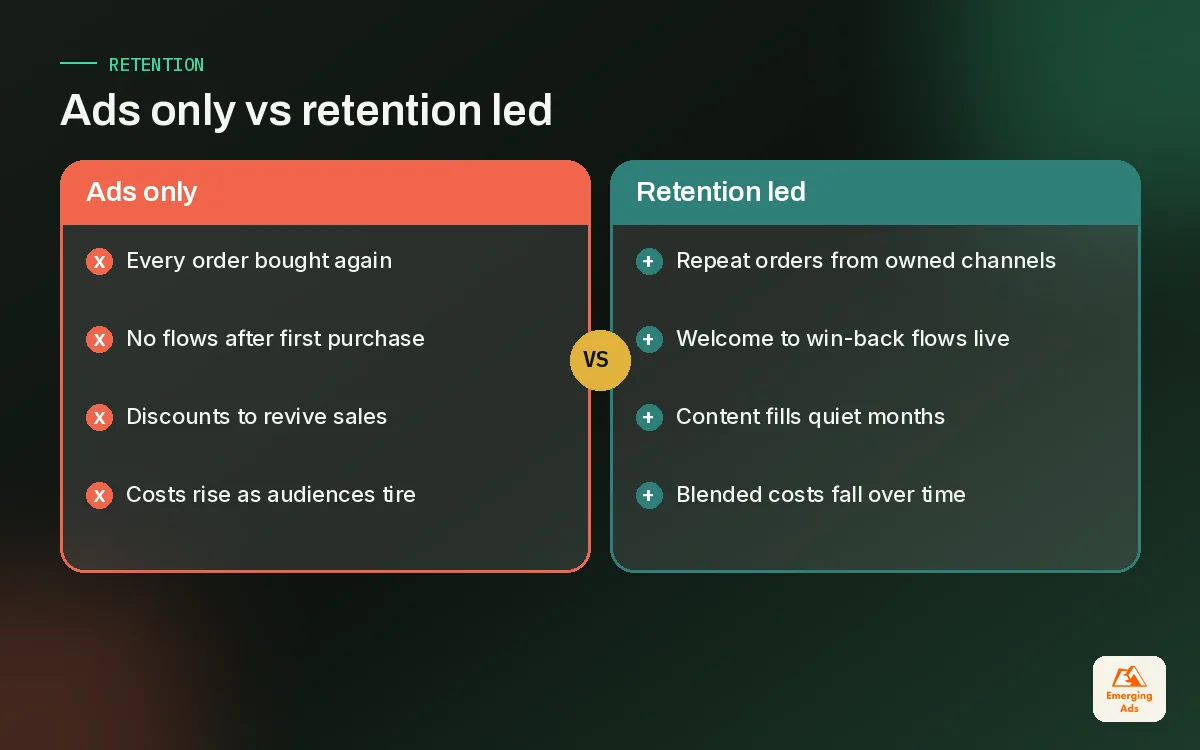
Acquisition gets a customer once. Retention decides whether that customer was worth paying for. On the Shopify stores we run, the brands that grow steadily are almost always the ones whose second and third orders come from owned channels rather than more ads.
Email: the backbone
Email is where retention starts. The essential automated flows are a welcome series, abandoned browse and checkout, post-purchase, a replenishment or cross-sell nudge and a win-back. Campaigns on top of that tell stories, launch products and run promotions. Most of our Shopify clients run this on Klaviyo, and our Klaviyo email marketing service handles the strategy, design and flows. If you are building from scratch, our main site has a practical rundown of the ecommerce email flows worth setting up first.
SMS: for moments that matter
SMS works best when it is rare. Launch alerts, back-in-stock messages and delivery updates suit it. Weekly promotional blasts usually do not, and they burn the list quickly. Get clear consent and keep messages short and useful.
WhatsApp: conversation, not broadcast
For brands whose customers like to ask questions before buying, such as jewellery, furniture or skincare, WhatsApp can be a quiet sales channel. Order updates, product questions and personal recommendations happen in one thread. Our WhatsApp for ecommerce setups focus on replies and service first, with broadcasts used carefully.
Paid ads rent attention. Email, SMS and WhatsApp let you keep some of it.
05Building a Shopify marketing promotions calendar
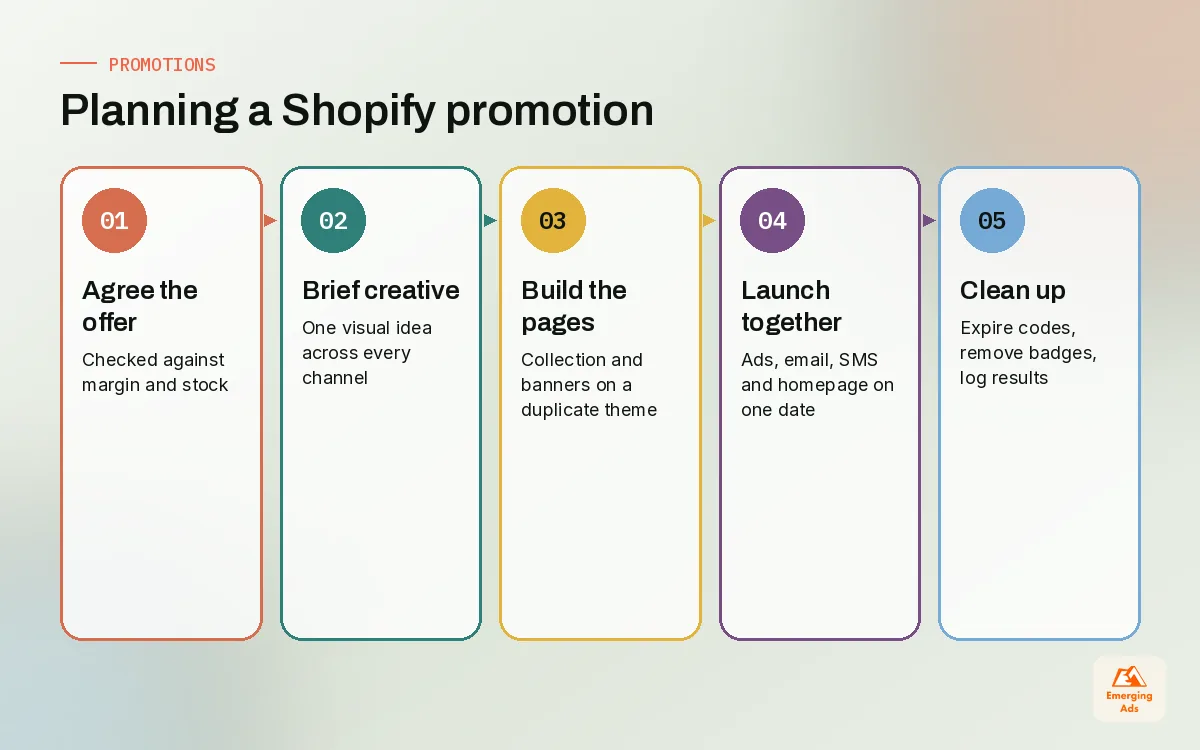
Without a calendar, promotions happen when revenue dips, which is the worst possible time to plan anything. A good Shopify marketing calendar is planned a quarter ahead and agreed with the people who make creative, manage stock and run the store.
| Moment | Typical lead time | What to prepare |
|---|---|---|
| Product launch | 6 to 8 weeks | Waitlist, teaser content, launch email and ads, stock confirmed |
| Major seasonal sale | 8 to 10 weeks | Offer agreed on margin, creative batch, collection and banners built on a duplicate theme |
| Gifting season | 6 weeks | Gift guides, delivery cut-off messaging, bundles and gift wrap options |
| Restock or back in stock | 1 to 2 weeks | Back-in-stock alerts, email to waitlist, short social push |
| Quiet months | 4 weeks | Content, reviews push, loyalty offers and retention campaigns rather than discounts |
The lead times above are what we plan for on our own accounts; larger catalogues and brands with long production times need more. The quiet months row matters most. Stores that fill every gap with a discount teach customers to wait. Stores that fill gaps with useful content, new reviews and customer stories keep full price meaning something.
One offer, many channels
Every promotion should run as one coordinated push: the same offer, the same dates and the same visual language across ads, email, SMS, the homepage and the collection. Shopify Flow can help here, for example tagging customers who used a launch code so they can be thanked or excluded later.
06Splitting your Shopify marketing budget by stage
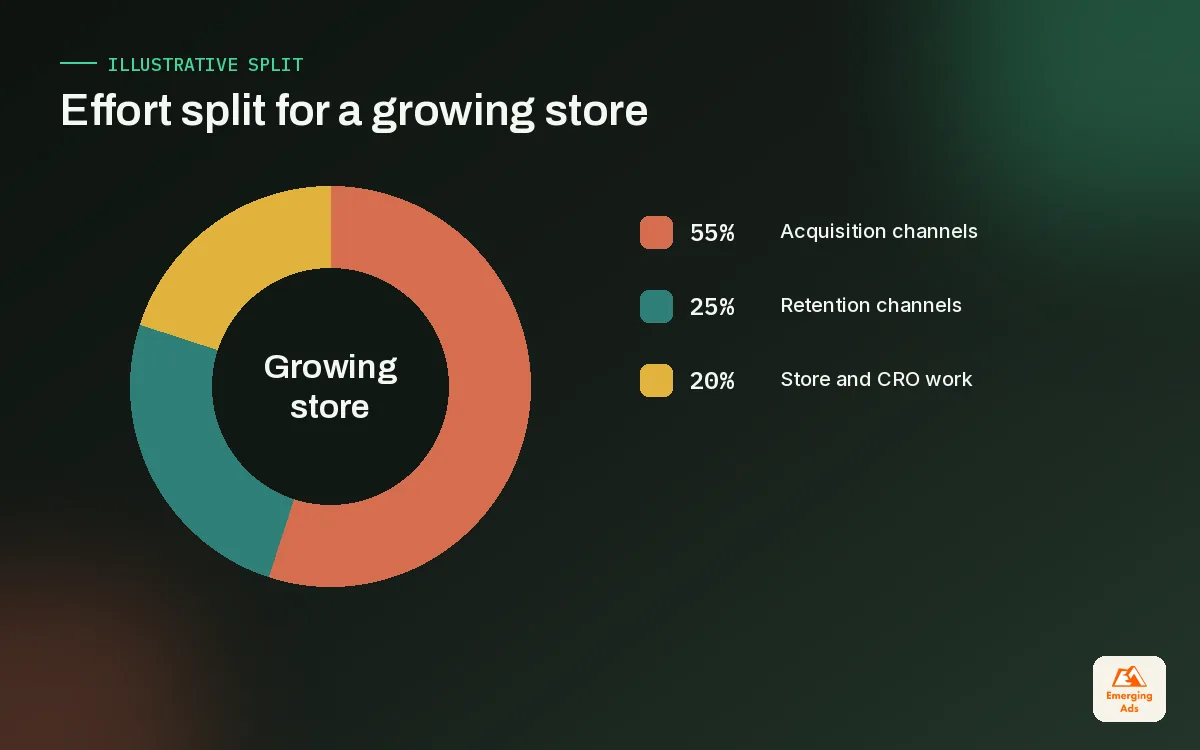
Budget questions usually come framed as “how much should we spend on Meta?”. The better question is how to split effort across acquisition, retention and the store itself at your current stage. Here is how the split typically shifts on the accounts we manage.
| Store stage | Acquisition | Retention | Store and CRO | Focus |
|---|---|---|---|---|
| New (proving demand) | Most of the budget, one channel | Core flows only | Fixes as found | Find one product and message that sells |
| Growing (finding scale) | Large share, two channels | Growing share, campaigns added | Regular testing | Make paid traffic profitable on repeat orders |
| Established (protecting margin) | Smaller share, several channels | Large share, segmented | Continuous programme | Lift lifetime value and lower blended costs |
We deliberately do not put percentages on this. The right split depends on margin, category and how much of your revenue already comes from returning customers, and invented percentages would mislead you. What holds true across accounts is the direction: as a store matures, retention and conversion work take a larger share of attention.
Move money slowly
When a channel is working, increase budget gradually and watch the blended numbers, not just the platform’s own report. When one stops working, cut it back before cutting it off, and check creative and landing pages first. Dramatic swings make it impossible to learn what caused what.
07What to track in your Shopify marketing each week
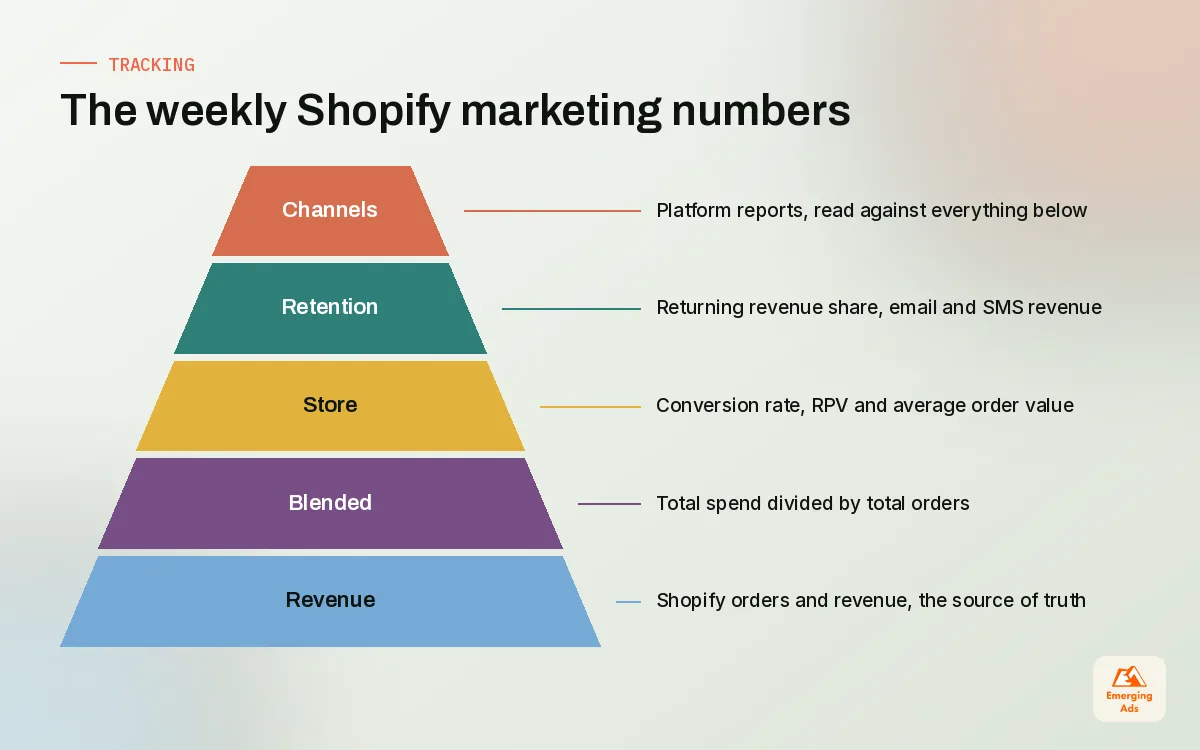
You do not need a forty-metric dashboard. You need a handful of numbers read every week by the same people. Ours fits on one page:
- Revenue and orders from Shopify, the source of truth for sales.
- Blended cost per order: total marketing spend divided by total orders, so channels cannot each claim the same sale.
- Revenue per visitor and conversion rate, to see whether traffic quality or the store is changing.
- Average order value, especially during promotions.
- Share of revenue from returning customers, the simplest health check on retention.
- Email and SMS revenue as a share of total, split by flows and campaigns.
Platform dashboards will each tell a flattering story. Reading channels together against Shopify’s own numbers keeps everyone honest. If you want the deeper reporting setup, that belongs in a proper analytics project, but this weekly page is enough to make good decisions.
08Putting your Shopify marketing plan to work
If you take one thing from this, make it focus. Pick the stage you are honestly at, build the store, tracking and retention layers, choose one acquisition channel that fits how your customers shop, and plan the next quarter of promotions on a single page. Review the weekly numbers every Monday. Add a second channel only when the first has an owner and a rhythm.
Keep the tooling lean while you do it. Many marketing apps promise growth and deliver page weight instead, and our guide to choosing Shopify apps without regret explains how we decide what stays.
If you would rather have one team run the whole plan, our Shopify ecommerce marketing service brings ads, email, SEO and store work together under one roof, with the store itself looked after by the same people. You can browse every channel we cover on our services page, read examples on our client success stories, or meet the people behind this guide on the teamemergingads.com homepage.
Shopify marketing does not reward the store that does the most. It rewards the store that does the right few things, properly, every week.
Frequently asked questions
Straight answers to what clients ask us most about shopify marketing.
What is the best marketing channel for a Shopify store?
How should a new Shopify store start marketing?
How much should I spend on Shopify marketing?
Is SEO worth it for a Shopify store?
Should I run Google Shopping or Performance Max first?
Is email marketing still worth it for Shopify brands?
Does WhatsApp marketing work for ecommerce?
How far ahead should I plan Shopify promotions?
Why do my ad platforms report more sales than Shopify?
When should a Shopify store add a second ad channel?
Should I discount every month to keep sales up?
Not sure which channels your Shopify store should run next?
We will look at your store stage, margins and current channels and tell you where your next marketing budget should go. Plain answers, no channel we do not believe in.
Book your free audit